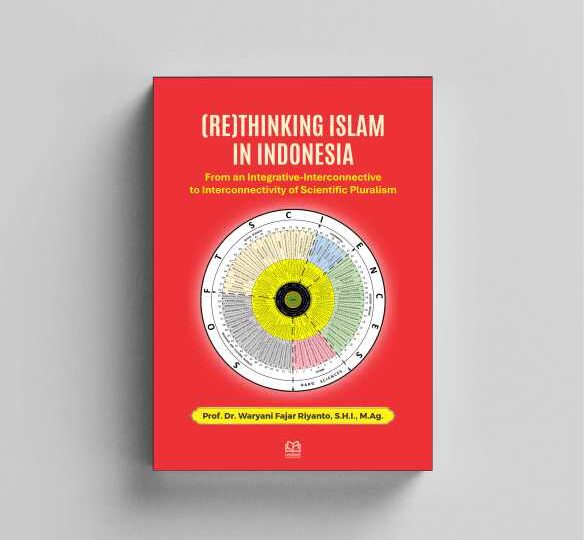
(RE)THINKING ISLAM IN INDONESIA: From an Integrative-Interconnective to Interconnectivity of Scientific Pluralism
Penulis: Prof. Dr. Waryani Fajar Riyanto, S.H.I., M.Ag.
ISBN: 978-634-7222-50-3
Penerbit: LaksBang Akademika
Cetakan I: September 2026
Deskripsi: vii, 404 hlm.; 16×23 cm.
Harga: Rp 225.000,-
Sinopsis
The third key concept in the integration–interconnection of science is creative imagination. Although inductive and deductive reasoning have adequately explained certain aspects of how scientific inquiry operates, they generally overlook the role of the scientist’s own creative imagination in the advancement of knowledge. There is indeed a logic for testing theories, but there is no logic for creating theories. There is no definitive formula for producing original discoveries. Most scholars aspire, throughout their academic careers, to develop new theories. Doctoral students are likewise consistently encouraged by their supervisors to present novel findings as a contribution to knowledge. How, then, do new theories emerge? New theories often arise from the courage of scientists and researchers to combine ideas that have previously existed but remained isolated from one another.
Finally, to strengthen the pillar of creative imagination, I propose the concept of religious imagination on Sufism through two articles (Chapter 3) based on Sufi cosmology, the thought of Ibn ʿArabī, and Frithjof Schuon’s perennial philosophy. The first is Frithjof Schuon (1907–1998) on the Transcendent Unity of Five Divine Presences. Probably the most famous teaching of the School of Frithjof Schuon (1907–1998), the Perennial Philosopher and Spiritual Poet, after the Transcendent Unity of Religions (al-waḥdat al-mutāʿaliyyah li al-adyān) is that of the Five Divine Presences (al-ḥaḍrah al-ilāhiyyah al-khamsah). Although often discussed, seldom has it been analyzed with reference to the original texts. From Sufi cosmology and models theory (monadic, diadic, triadic, tetradic, and pentadic) perspectives, this study analyzed Schuon’s thoughts on the Five Divine Presences. Employing a qualitative document-based methodology, the study analyzed primary texts by Schuon. The study advances the concept of the Transcendent Unity of Five Divine Presences that consists of Beyond-Being, Being, Spirit, soul, and body. These five structures place Spirit (rūḥānī) as the bridge between God and man. Spirit (rūḥānī) is the Logos, which with its two faces, created and uncreated, the “bridge” between man and God. Created, observed from the God side and uncreated, observed from the human side. The implication is that Pentadic Integralism can describe and clarify clearly between domains of Uncreated Logos–Created Logos, Absolute–Relative, Ātmā–Māyā, Divine–Human, Heaven–Earth, Esoterism (Ḥaqīqah)–Exoterism (Syarīʿah), and Immortal–Mortal. The current study also attempts to integrate between Perennial and Sufism.